We’ve been shipping production-grade agentic AI in voice for years—banking, healthcare, utilities, government, QSR drive-thrus. Not demos. Not pilots. Real systems handling billions of interactions annually for over 130 Fortune 200 enterprises.
So when Google’s internal playbook on AI agents leaked this week, we didn’t flinch. We nodded.Because everything they described as hard—we solved years ago.
What Google Got Right
The leaked 64-page document states it plainly:
“Due to the non-deterministic nature of LLM-based systems, it can be hard to achieve production-grade reliability. Moving beyond superficial ‘vibe-testing’ requires a rigorous engineering approach to ensure an agent operates safely and provides consistent value.”
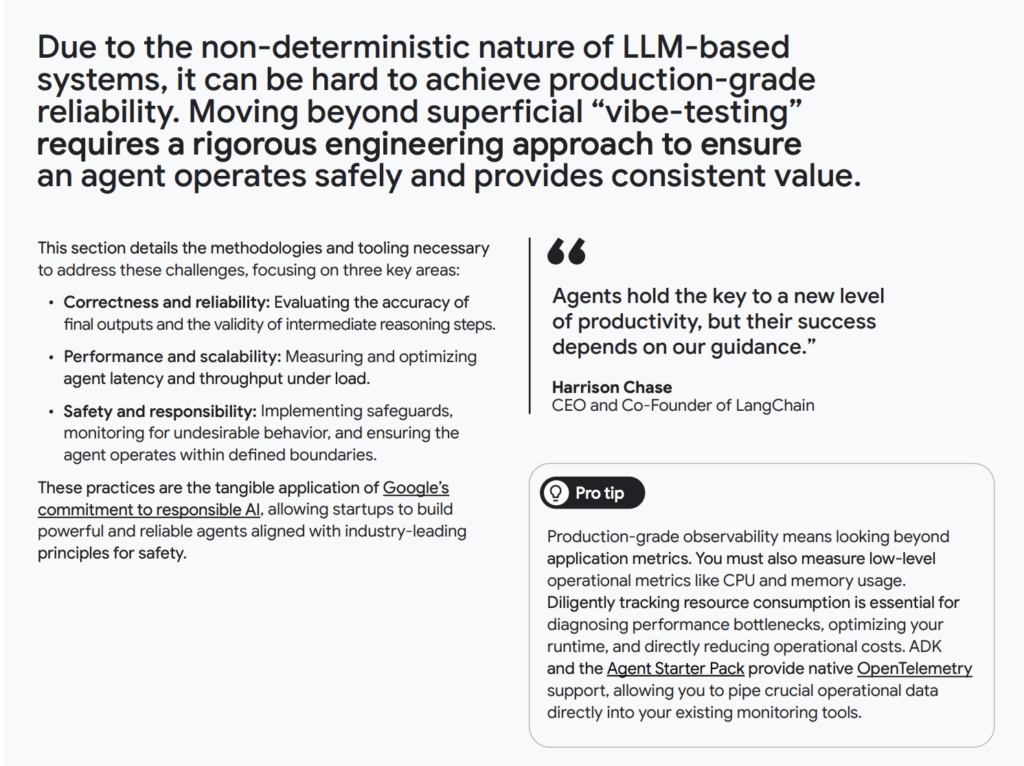
They’re correct. And the rest of the paper offers no working solution to this problem.
Robert Youssef’s summary on X captured the industry reaction: every “AI agent” demo you’ve seen is essentially three ChatGPT calls wrapped in marketing. The agents your favorite startup demoed last week? API calls with fancy prompts.
The Production Agent Standard
Here’s what nobody in the demo-first crowd wants to talk about: there are six non-negotiable requirements for agents that can actually replace human work in enterprise environments.
1. Deterministic, Explainable, and 100% Hallucination-Free
If your agent only works most of the time, it doesn’t work. Enterprise operations require systems that are deterministic, observable, auditable, and produce zero hallucinations. Not “low hallucination rates”—zero.
2. Security and Compliance That Survives Real Audits
PCI DSS Level 1. HIPAA. FedRAMP. The CISO of a major bank signs off on your yearly audit—or you don’t operate. Prompt injection from bad actors isn’t a theoretical concern; it’s a daily reality.
3. Scale to Tens of Thousands Concurrent
Here’s an industry secret: most “agentic” software doesn’t scale beyond 50 concurrent agents. Most probably never will. Enterprise peak hours demand tens of thousands of concurrent agents serving tens of thousands of customers simultaneously.
4. Sub-500ms Latency for Natural Voice Interaction
Not chat. Voice. Real-time, spoken conversation with customers who expect human-level responsiveness. The threshold for natural agentic discourse is well below 500ms.
5. Fixed, Transparent Cost Structure
CFOs kill agentic projects. Every single one that doesn’t have a predictable cost-per-interaction model gets axed before it moves from innovation to production. If you can’t tell the finance team exactly what the agentic operation costs every time, you’re building a science project, not a product.
6. Competitive with What Actually Works Today
DTMF IVR systems still handle 60% of the market. They’re old, customers hate them, but they’re effective and cheap. Your agent has to outperform humans and cost less than the ugly-but-functional systems enterprises already have.
Why Demo-First Vendors Failed
The past few years, AI vendors targeted the Chief Innovation Officer—the executive with limited budget and permission to fail. Their agents were designed to excel at one thing: getting the pilot approved.
So they shipped demos. Beautiful, carefully curated, scripted demos.
Now enterprises want to scale. And shockingly, those demos don’t scale.
The problem isn’t agents. The problem is vendors who’ve never run them in the real world.
What Actually Works (And Has for Years)
At Omilia, we didn’t start with agents. We started with millions of real customer conversations. Then hundreds of millions. Then billions of learning signals across voice-first, high-stakes environments.
We had to pass yearly security audits from Fortune 50 banks. We had to load test with 20,000 concurrent agents. We had to deliver ROI that beat legacy IVR systems—not just theoretically, but in production. We had to operate at sub-300ms latency to make voice interactions worthwhile.
We had to do all that without endless professional services engagements that drain budgets and kill timelines.
The result: a platform that
- Learns from real outcomes and live customer interactions, not synthetic success
- Replaces humans only when it measurably outperforms them and costs less
- Is auditable, explainable, and secure enough for the most regulated industries
- Is proven across 130+ referenceable Fortune 200 customers, handling billions of voice interactions annually
And by the way—our demo runs on the same self-learning agentic software that serves the biggest enterprise customers in North America today.
The Bottom Line
If your takeaway from the Google leak is “agents were a mistake,” you’re aiming at the wrong target.
Agents aren’t the problem.
Pretending is.
Enterprises can tell the difference now.
See how Omilia delivers production-grade agents
About Omilia
Omilia’s Self-Learning Agentic CX Platform delivers production-grade conversational AI for enterprise contact centers. Unlike demo-first vendors, Omilia has spent over a decade solving the hard problems of reliability, security, compliance, and scale in voice-first environments.

About the Author
John Nikolaidis, Co-Founder
John Nikolaidis is Co-Founder and Managing Director of Omilia, a leading provider of conversational AI solutions for enterprise contact centers.