
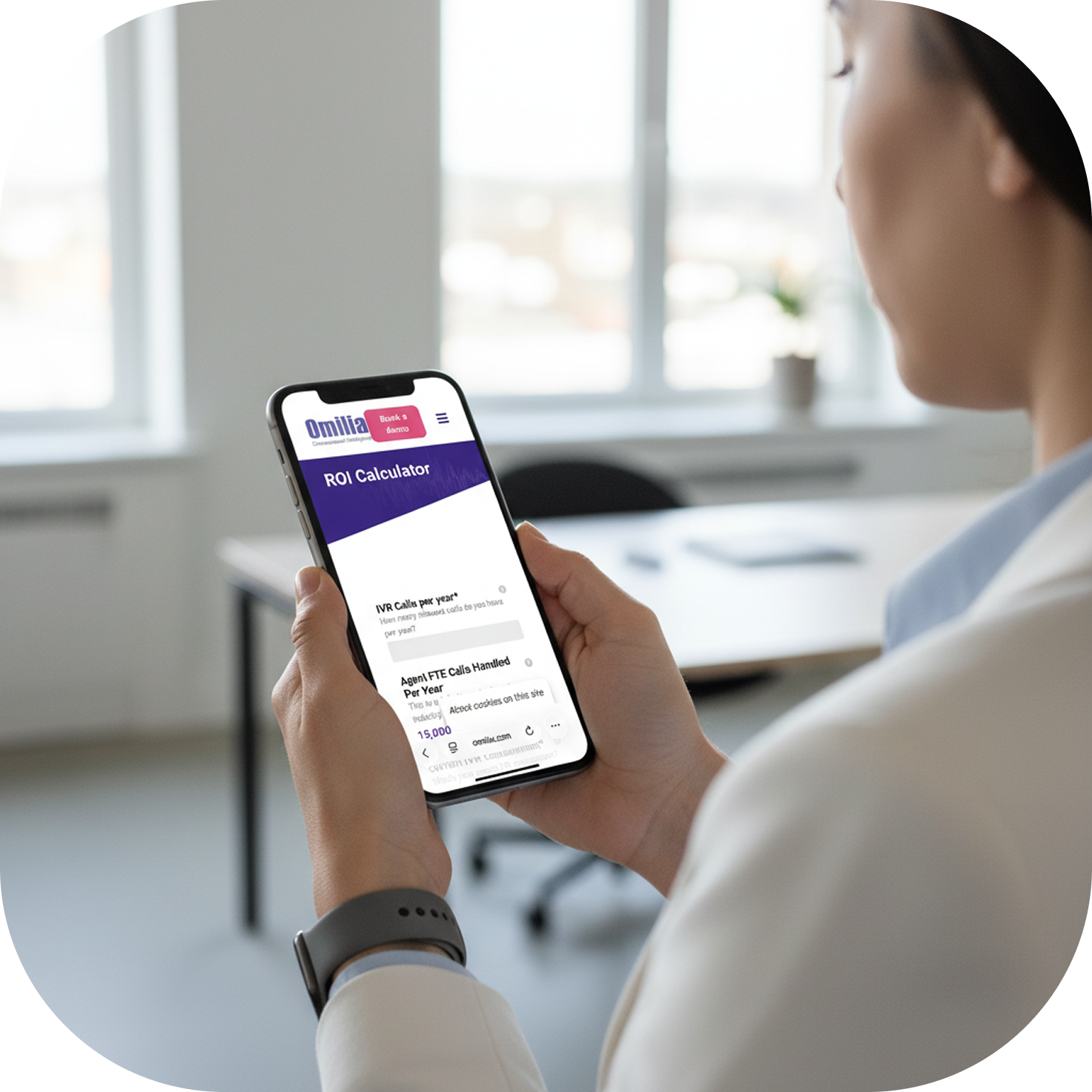
Every contact center is different — call volumes, agent costs, and current automation levels all affect the business case for AI. This calculator models the financial impact of deploying Omilia’s AI platform based on your own numbers, using benchmark data drawn from real customer deployments.
Adjust the inputs to match your operation. The results reflect containment rates and cost savings that Omilia enterprise customers typically achieve within the first 12 months of production deployment.
What Omilia customers typically achieve
The following figures are drawn from live enterprise deployments. Use them as a sense-check against your calculator results.

70–95%
Call containment rate for routine inquiry types

3:1
Average ROI within 12 months of deployment

6–12 month
Typical payback period at enterprise scale
Real results from Omilia customers
These are verified outcomes from named enterprise deployments — not modelled projections.
Verified outcomes from named enterprise deployments using Omilia.
| Customer | Result | What changed |
|---|---|---|
 |
25% → 55% containment | Replaced legacy IVR with Omilia voice agents for customer service automation across multiple markets |
 |
95% chat containment | Deployed Omilia chatagents for shipping and delivery inquiries, achieving near-complete digital self-service in weeks |
 |
Misrouted calls: 40% → 15% | Intelligent call routing and automation reduced agent handle time and eliminated the most common routing failure mode |
 |
35–40% containment | Automated inbound energy customer service calls from day one using pre-built utility industry models |
How the calculation works
The calculator estimates annual savings from three sources:
-
Call containment savings
The number of calls newly contained by AI (incremental containment) multiplied by the fully loaded cost per agent-handled call
-
Agent FTE savings per call contained
Derived from your agent annual cost divided by calls handled per year — representing the saving on each call shifted from agent to AI
-
Total agent calls after automation
Your remaining live-agent volume once the new containment rate is applied
The calculator uses a conservative model. It does not factor in secondary savings such as reduced after-hours staffing, lower agent churn, reduced training costs, or CSAT-driven revenue retention — all of which Omilia customers report as material benefits.
Frequently asked questions
What ROI can I realistically expect from conversational AI?
Omilia enterprise customers typically achieve 3:1 to 5:1 ROI within 12 months of deployment. The primary driver is call containment — routing routine inquiries to AI virtual agents instead of live agents. At an average fully-loaded agent cost of $6–12 per call, containing 50% of a 1 million call annual volume can generate $3M–$6M in annual savings. Secondary drivers include reduced handle time on calls that do reach agents and lower agent churn.
What containment rate should I expect?
Containment rates vary by use case and industry. For routine, high-volume inquiry types — balance checks, payment processing, address updates, order status — Omilia customers typically achieve 70–85% containment. For more complex interactions involving exceptions or escalations, 40–60% is more typical. Purolator achieved 95% chat containment; Nissan improved from 25% to 55% voice containment. Your calculator result reflects your specific inputs — enter your current containment rate to see the incremental improvement.
How long does it take to see a return?
Most Omilia enterprise deployments achieve payback within months. Deployment itself can be rapid — Omilia offers a go-live in days using hundreds of pre-built industry deterministic agents and self-learning agentic agents, meaning automation starts generating savings almost immediately rather than after a months-long build phase.
Does the calculator account for implementation costs?
The current calculator focuses on the savings side of the equation. Implementation costs vary depending on your CCaaS platform, integration complexity, number of languages, and deployment scope. Contact Omilia for a full business case that includes implementation investment alongside projected returns.
How does Omilia integrate with my existing contact center platform?
Omilia integrates via click-button connectors with all major CCaaS platforms — including RingCentral, NiCE, Avaya, Amazon Connect, Five9, Cisco, and Talkdesk. The platform deploys alongside your existing infrastructure without requiring a replacement. Your current agent workflows, routing rules, and reporting tools remain in place.